

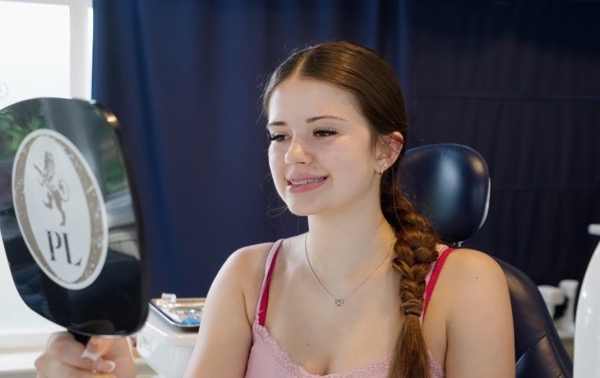
If you’re considering orthodontic treatment as an adult and you had braces as a teenager (or you’re an adult who didn’t, and always assumed you’d missed the window), you may be working with some outdated assumptions about how adult treatment compares to the version you remember from school.
The differences are real, but they’re not the ones most people expect. Adult orthodontic treatment is not simply the same process wearing older shoes. There are genuine clinical and practical distinctions that are worth understanding before you start.
Bone is different in adults
This is the fundamental biological difference, and it affects everything downstream.
In children and teenagers, the jaw is still growing. The bone surrounding the teeth is more responsive, and teeth move through it relatively readily. Orthodontists treating younger patients can work with a jaw that is actively remodelling, a fact that makes certain types of treatment, particularly those affecting the relationship between the upper and lower jaw, more effective and less invasive during growth.
In adults, jaw growth is complete. The bone is denser and more settled, and tooth movement typically proceeds at a slightly slower pace. This doesn’t mean adult treatment is less effective. It means the clinical approach needs to reflect the biology of a mature jaw. For straightforward alignment cases, the difference in treatment speed is minimal. For cases involving significant jaw discrepancy, the options available to an adult may be different from those available to a teenager.
This is one of the most important reasons to see a specialist orthodontist rather than a general dentist when considering adult treatment. The clinical assessment needs to account for this distinction properly.
Treatment length tends to be slightly longer for adults
As a broad generalisation, adult orthodontic treatment takes a little longer than equivalent treatment in a teenager. There are exceptions (mild adult cases can be completed in six to nine months), but as a rule, the denser bone of an adult jaw moves teeth more slowly than the more pliable bone of an adolescent.
This isn’t a reason to delay treatment. Every year of not treating an orthodontic problem that will benefit from treatment is a year of continued wear, increased difficulty in cleaning around misaligned teeth, and often a gradual worsening of the issue. Beginning treatment now produces a result sooner than beginning treatment later.
Adults manage their own compliance
This is a practical difference that cuts both ways.
When a teenager has orthodontic treatment, the compliance responsibility is shared, largely by parents, who supervise brushing, remind about aligner wear, and ensure appointments are kept. Adults self-manage entirely.
For most adults, this is actually an advantage. You’re choosing this treatment for yourself, usually at a point in life when you’re genuinely motivated by the outcome. You understand the investment and you want the result. That level of personal investment translates to better compliance with removable aligners, better cleaning around fixed braces, and better attendance at appointments.
The flip side is that there’s no external accountability. If you’re considering Invisalign as an adult, it’s worth being honest with yourself about whether you’re the kind of person who will remember to put the aligners back in after every meal, every day, for the full course of treatment. For patients who aren’t sure, fixed braces remove that variable entirely, as they work continuously without any action on your part.
The social and professional context is different
Teenagers having orthodontic treatment are surrounded by peers doing the same. Braces are entirely unremarkable in a secondary school. For adults, the calculus is more personal.
Many adults choose discreet treatment options (clear aligners, ceramic braces, or lingual braces) because the professional or social context of their life makes visible metal brackets feel incompatible with how they present themselves. This is a completely valid consideration, and it’s one that the range of modern treatment options handles well.
Invisalign aligners are genuinely discreet at conversational distance. Ceramic braces are far less prominent than metal. Lingual braces, fitted to the back of the teeth, are invisible from the front. For most adults, there is a treatment option that fits their level of comfort around visibility.
At Park Lane Orthodontics, our specialist team (including Shivani, a consultant orthodontist and Diamond Apex Invisalign provider) can assess which of these options is clinically appropriate for your case and talk through the practical trade-offs of each.
Adults are more likely to have existing dental work
This is a clinical consideration that doesn’t apply to most teenagers but is relevant for many adults.
Crowns, bridges, veneers, implants, and fillings all affect how orthodontic treatment is planned. Teeth with significant restorations may need different clinical approaches. Implants, in particular, are fixed in the bone and cannot be moved orthodontically, something that has to be factored into the treatment plan if an implant is present in an area where movement is needed.
A specialist orthodontist will assess all of this at consultation and factor it into the treatment plan from the outset. It’s one of the less visible advantages of a thorough specialist assessment over a quick evaluation by a generalist.
The outcome can be genuinely life-changing at any age
Adults who have orthodontic treatment consistently describe the emotional impact as significant. Years of habits (covering your mouth when you laugh, choosing angles in photographs, holding back in situations where you’d otherwise be confident) don’t disappear overnight, but many patients report a shift in how they carry themselves that extends well beyond the smile itself.
At Park Lane, we regularly see adults in their forties, fifties, and beyond. We’ve treated patients from Reading, Abingdon, Caversham, and across Berkshire who’d been telling themselves for years that they’d missed the window. They hadn’t. The biology is different, the options may be different, but the results are real. You can see examples of finished cases in our smile gallery.
Ready to find out what’s possible?
Our three-part consultation gives you a complete specialist assessment, a clear set of treatment options, and full transparency on cost, all in a single 90-minute appointment for £150.
Call us on 0118 941 1628 or email smiles@parklaneorthodontics.co.uk. We’re based in Tilehurst, Reading, with on-site parking. If you’re coming from Woodley, Theale, Pangbourne or further afield, you’re very welcome.
FAQ
Is adult orthodontic treatment more painful than teenage treatment?
Discomfort patterns are broadly similar. Some adults report that their teeth feel more tender for longer after adjustments, though this varies considerably from person to person. Over-the-counter pain relief is usually sufficient and discomfort typically settles within a few days of each adjustment.
Will my teeth be more prone to relapse as an adult?
Not necessarily more so than after teenage treatment, but retention is equally important for adult patients. Wearing retainers as directed after treatment is essential regardless of age. At Park Lane, post-debond monitoring continues for a year after treatment ends.
I had braces as a teenager and my teeth have moved back. Can I have treatment again?
Yes. This is a very common scenario. Your orthodontist will assess the current position of your teeth and recommend the most appropriate approach. In some cases, the solution is simpler than you might expect.
Does adult orthodontic treatment take significantly longer than teenage treatment?
It varies by case. Some adult cases, particularly mild crowding treated with clear aligners, complete in under a year. More complex cases can take longer. Your orthodontist will give you a realistic timeline at consultation based on your specific assessment.